

How the Tilt-Rotator Bucket Boosts Ballast Operation Efficiency?
In the fields of railway maintenance and construction, ballast cleaning, backfilling, and shaping are critical steps that determine track quality and operational efficiency. Faced with complex track conditions and rigorous operational standards, traditional construction methods often require significant manpower and frequent repositioning of machinery. Tiannuo Machinery’s TNXZQX series tilt-rotator bucket offers a highly efficient and precise solution for railway ballast operations, featuring 360-degree rotation and 40-degree tilting capabilities.
What is a Tilt-Rotator Bucket?
A tilt-rotator bucket is a multifunctional attachment mounted on the front of an excavator; its core feature is the addition of a flexible "joint" to the bucket. Positioned between the excavator arm and the bucket, this mechanism allows for continuous rotation and lateral tilting without requiring the entire machine to move. Specifically designed for railway environments, this product from Tiannuo Machinery boasts an effective working width of 1500–1600 mm. It effectively covers the ballast working area for standard track gauges (1000/1435/1520 mm), enabling backfilling and shaping to be completed in a single pass.
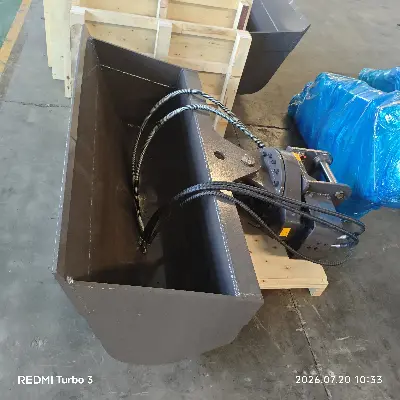
Key Advantages for Railway Ballast Operations
The advantages of the tilt-rotator bucket are particularly evident during ballast backfilling and track shoulder shaping operations. Specifically, it delivers the following benefits:
Significantly Boosts Operational Efficiency: Traditional methods rely on frequent excavator repositioning to adjust angles, whereas the tilt-rotator bucket allows the operator to control the bucket's rotation and tilt directly from the cab. This minimizes unnecessary machine movement; industry estimates suggest it significantly reduces the time required for a single work cycle.
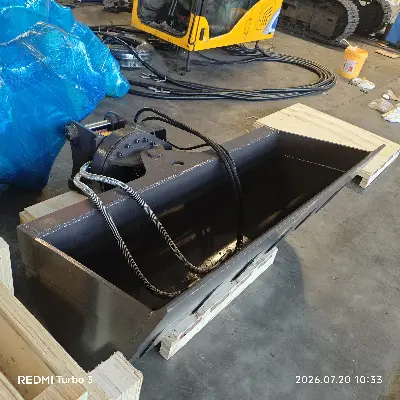
Enables Precise Slope Shaping: The 40-degree tilt angle easily meets standard slope requirements for railway shoulders. Operators can precisely shape the ballast slope in one pass—eliminating the need for repeated leveling or manual finishing—thereby improving the consistency of the track bed's appearance and enhancing drainage performance.
Adapts to Confined Trackside Operations: In the limited spaces between tracks or immediately adjacent to the line, the 360-degree rotation function allows the bucket to flexibly adjust its discharge direction. Whether replenishing ballast in the center of the track or casting it to the sides, the bucket handles these tasks with ease, reducing operational complexity.
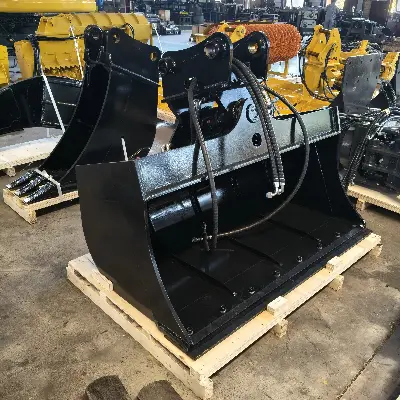
Technical Specifications Analysis
Based on Tiannuo Machinery’s product specifications, the TNXZQX075 and TNXZQXDI50 models are designed for 7–10 ton and 13–15 ton excavators, respectively, covering the small-to-medium tonnage equipment commonly used in railway maintenance. In terms of technical performance, they feature the following:
Rated Flow and Pressure: Both models operate at 40 L/min and 12 MPa, ensuring excellent compatibility with the hydraulic systems of mainstream excavators and delivering stable, powerful output.
Effective Working Width: With widths of 1500mm and 1600mm, these buckets efficiently cover the ballast width of standard tracks without requiring overlapping passes, thereby reducing the total number of passes needed.
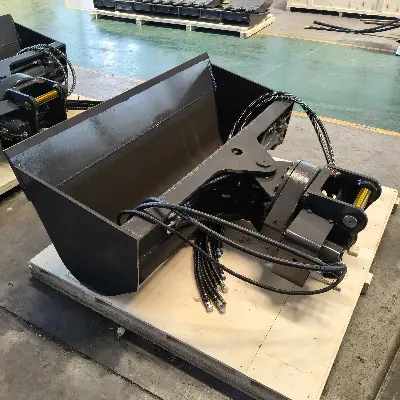
Structural Strength: Weighing 635kg and 765kg respectively and constructed from high-strength materials, these buckets ensure structural durability and reliability during continuous, heavy-duty ballast operations.
Conclusion
For railway construction enterprises, adopting a tilt-rotator bucket represents not merely the addition of a new attachment, but an optimization of operational workflows. By minimizing the need for machine repositioning, improving slope shaping precision, and enhancing maneuverability in confined spaces, it directly saves time and reduces costs for projects.
Tiannuo Machinery’s (www.stnd-machinery.com) TNXZQX series tilt-rotator buckets—characterized by designs tailored to railway operating conditions, reliable hydraulic performance, and efficient multi-angle operational capabilities—serve as powerful assets for boosting efficiency in railway ballast maintenance and track construction.