

Top-Rated Degree Rotating Hydraulic Tilt Ditching Bucket: 360° Rotation and 40° Tilt vs Any Fixed Railway Bucket
Railway shoulder work is where a fixed bucket stops being the right tool. The cutting edge sits at one angle, the excavator sits on rails it cannot freely reposition, and the operator ends up chasing the ballast profile with the boom instead of forming it with the bucket. Every extra pass burns possession time that cannot be recovered.

A degree rotating hydraulic tilt ditching bucket ends that compromise. 360° of rotation and 40° of tilt put the cutting edge exactly where the slope is, so the shoulder is formed in one setup instead of five. This is the bucket that turns a standard excavator into a purpose-built ballast shaping machine.
Built by Tiannuo Machinery in Jining, Shandong — a source factory with more than 14 years in excavator attachments and railway maintenance equipment, supplying contractors and fleet owners worldwide.
What Is a Degree Rotating Hydraulic Tilt Ditching Bucket?
It is a hydraulically controlled excavator attachment that combines two independent movements: a full 360° rotation of the bucket on its vertical axis, and a 40° tilt of the bucket body. Rotation positions the bucket; tilt shapes the material. Together they let the same machine backfill ballast, form the shoulder and dress a slope without being repositioned between tasks.
The body is built from Q460 high-strength steel with WH60C wear-resistant plate, and the bottom can be specified as a plane type or a grid type. Operation is entirely hydraulic, taking power from the carrier’s own auxiliary circuit rather than a separate power pack.
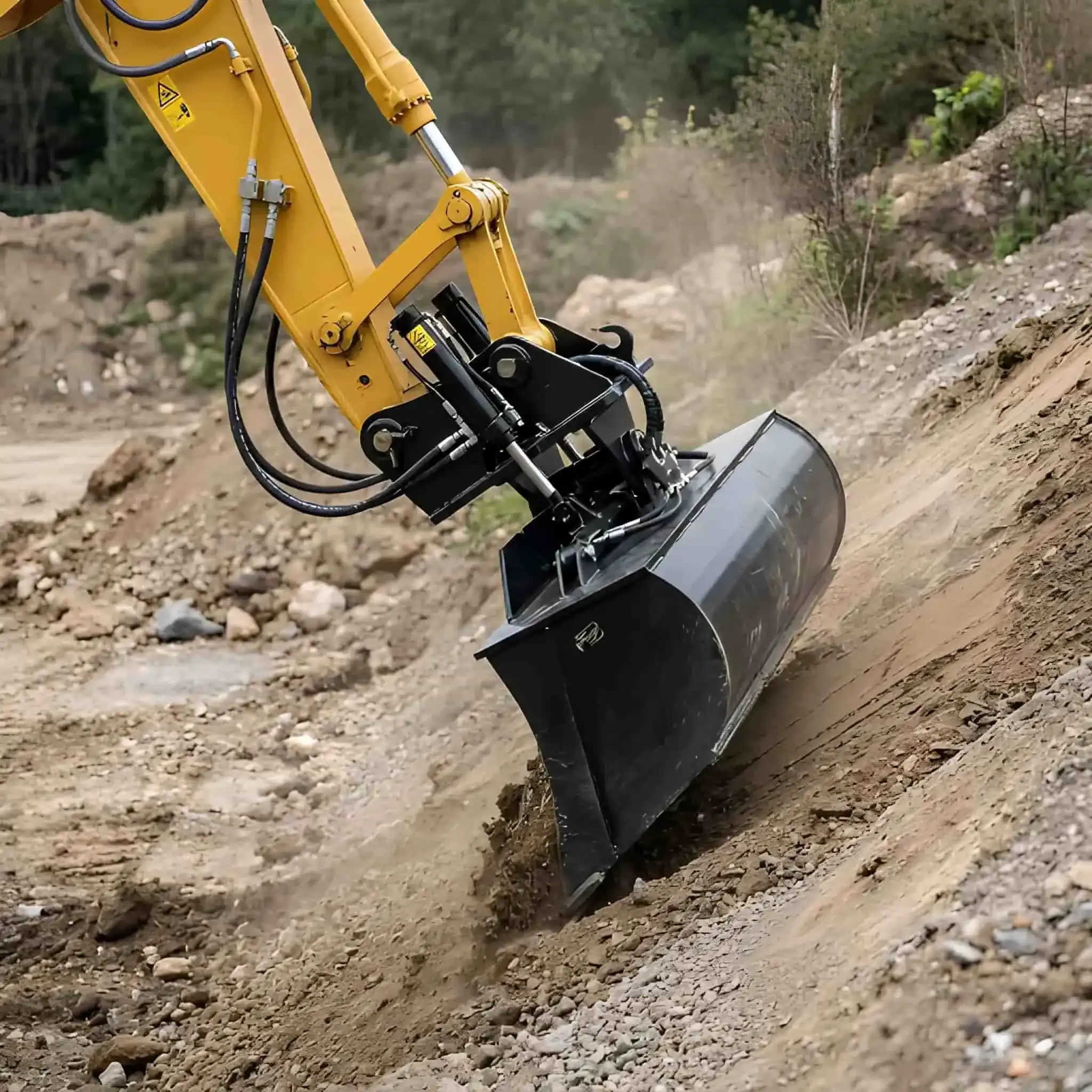
Rotating Tilt Bucket vs Fixed Ditching Bucket: The Difference That Pays
The comparison is not about build quality. It is about how many times the machine has to move.
A fixed ditching bucket — the edge can only meet the ballast at the angle the boom and machine position allow. Chasing a slope means repeated repositioning — and on track, repositioning is the expensive part
A rotating tilt bucket — the operator rotates the bucket to face the work and tilts it to match the slope. The machine stays put while the attachment does the adjusting
Side by side — one setup performs the pass that a fixed bucket needs several setups to achieve. In a possession window that is measured in minutes, that is the whole argument
That is why rotating tilt buckets have moved from a niche attachment to a standard item on serious railway maintenance fleets, and why they now outperform fixed buckets in shoulder forming, ballast backfilling and slope dressing.
Top 4 Reasons This Bucket Leads Its Class
1. 360° Rotation Plus 40° Tilt — The Best Positioning Freedom in Its Size Range
Rotation and tilt are separate functions, and that is the point. Rotation aims the bucket at the work; tilt sets the cutting edge to the gradient. Because both are hydraulic and operated from the cab, the operator can swing the bucket to the ballast stack, load it, rotate to the shoulder and tilt to the finished slope without leaving the seat and without moving the carrier.
On a live track where the machine has nowhere to go, this is the difference between forming a shoulder and fighting one.
2. Plane vs Grid Bottom — Two Buckets for the Price of One
The bucket bottom can be built as a plane type or a grid type, and the choice changes what the machine can do on site.
Plane bottom — carrying, placing and forming. Material is retained, so it moves ballast from the stack to the shoulder in controlled passes
Grid bottom — separating while digging. Fines fall through the grid while usable ballast stays in the bucket, which is how a site recovers material instead of buying all of it new
Specify the bottom to match the job. A fleet that needs both can order the two configurations and swap according to the work order.
3. Q460 + WH60C Build — Made to Outlast Ordinary Buckets
The body runs Q460 high-strength steel with WH60C wear-resistant plate at the working surfaces. Ballast is angular, abrasive and heavy; it eats a bucket from the floor and the lower side plates first. Using a high-strength structural grade for the body and a dedicated wear grade at the contact zones is what separates a bucket that survives seasons of shoulder work from one that is patched every year.
4. Matched Hydraulics — Top Compatibility, No Surprises
The attachment is specified at a rated flow of 40 L/min and a working pressure of 12 MPa. Those two figures are what decide whether a rotating attachment performs properly on your machine: a circuit that is short on flow will rotate slowly, and one that is short on pressure will stall under load. Publishing the numbers lets you check the carrier before the order, not after installation.

Technical Specifications
Two standard models cover the 7–15 t carrier range. Working angle is 40° on both, with full 360° rotation.
Item | TNXZQXD75 | TNXZQXD150 |
Applicable excavator (t) | 7–10 | 13–15 |
Applicable track gauge (mm) | 1000 / 1435 / 1520 | 1000 / 1435 / 1520 |
Effective working width (mm) | 1500 | 1600 |
Max height (mm) | 550 | 550 |
Working angle | 40° | 40° |
Rotating angle | 360° | 360° |
Rated flow (L/min) | 40 | 40 |
Working pressure (MPa) | 12 | 12 |
Weight (kg) | 635 | 765 |
Packing size (mm) | 1540 × 730 × 1450 | 1640 × 760 × 1490 |
Body material | Q460 + WH60C | Q460 + WH60C |
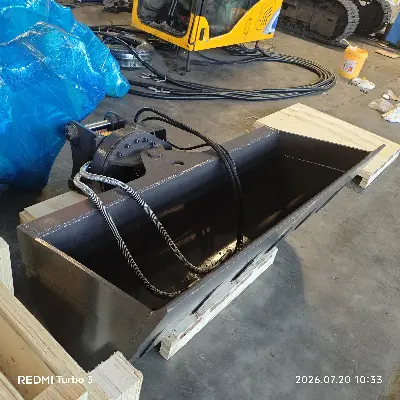
Best-Fit Applications
Railway ballast work — backfilling ballast and forming the shoulder to profile, the exact duty this bucket was specified for
Slope shaping — dressing and trimming slopes that a fixed bucket can only reach by moving the machine
Material recovery — the grid bottom screens while digging, so usable stone stays on site and fines are dropped
Multi-gauge projects — track gauge options of 1000, 1435 and 1520 mm cover metre gauge, standard gauge and CIS broad gauge networks
Confined track sections — the tilt function reaches where the boom cannot, in cuttings, stations and yards
How to Choose the Best Model: TNXZQXD75 vs TNXZQXD150
The split is simple, and it follows the carrier rather than the job:
TNXZQXD75 for 7–10 t machines — the 1500 mm effective working width and 635 kg body suit smaller carriers working confined sections and yards
TNXZQXD150 for 13–15 t machines — the wider 1600 mm cutting width and 765 kg body make it the better match for full-section shoulder forming
Two further checks before ordering: confirm the carrier’s auxiliary hydraulic flow and pressure against the 40 L/min and 12 MPa rating, and confirm the coupling — pin-on dimensions or quick coupler interface — so the bucket arrives ready to mount.

Why Tiannuo Ranks Among the Top Rotating Bucket Manufacturers?
Source factory, not a middleman — design and manufacture happen in our own plant, which is why specification changes go through engineering rather than a trading desk
Proven track record — more than 14 years building excavator attachments and railway maintenance equipment, including sleeper changers, ballast ploughs, undercutters and rail handling gear
Full-range customization — long arms, lifting cab conversions, specialised buckets and complete railway maintenance packages can be sourced and matched as one order
Specification transparency — a rotating tilt ditching bucket that is specified, built and checked against the figures published here, with hydraulic ratings you can verify against your own machine
Get the Best Price on a Rotating Tilt Ditching Bucket
Send us your excavator model, tonnage, track gauge and the auxiliary hydraulic flow and pressure, and we will confirm the right model — TNXZQXD75 or TNXZQXD150 — together with the bottom type and coupling for your machine. Contact our team at arm@stnd-machinery.com.
Shandong Tiannuo Construction Machinery Co., Ltd.
Add: No. 369, Hard Innovation Industrial Park, Deyuan Road, Yanzhou District, Jining City, Shandong Province
Website: www.stnd-machinery.com
Email: arm@stnd-machinery.com