

Why is it necessary to modify the lift cab?
Traditional excavator cabs are fixed, and in situations such as loading and unloading trains/trucks or handling bulk materials, the operator's view is easily obstructed by the cab walls, creating blind spots that affect efficiency and pose safety hazards. The core function of a liftable cab is to improve visibility, allowing the operator to directly see inside the cab or a larger working area.
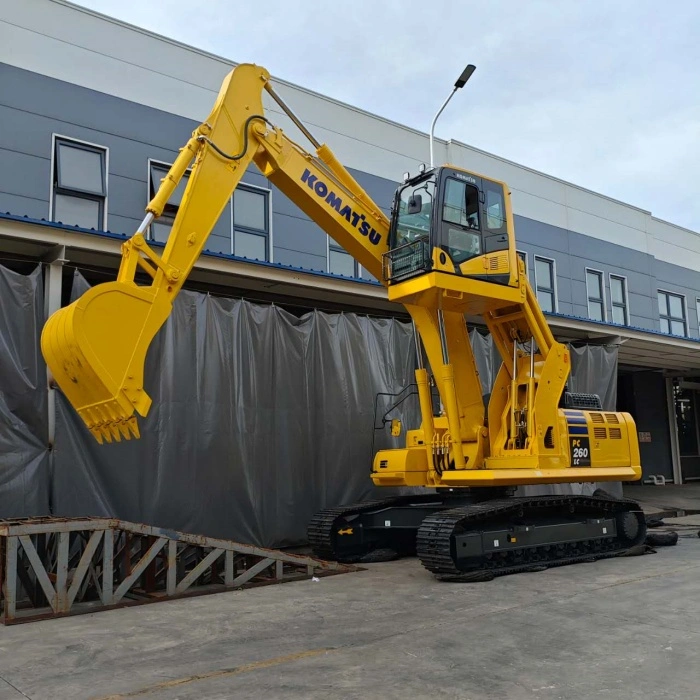
Core Structure: The cab is no longer directly mounted on the chassis, but is connected to the vehicle body via an auxiliary chassis supported by hydraulic cylinders.
Operation Method: The operator inside the cab controls the extension and retraction of the hydraulic cylinders using a handle, thus freely raising or lowering the cab. It is raised when a good view is needed and lowered when a higher view is not required for movement, lowering the overall center of gravity to ensure driving safety.
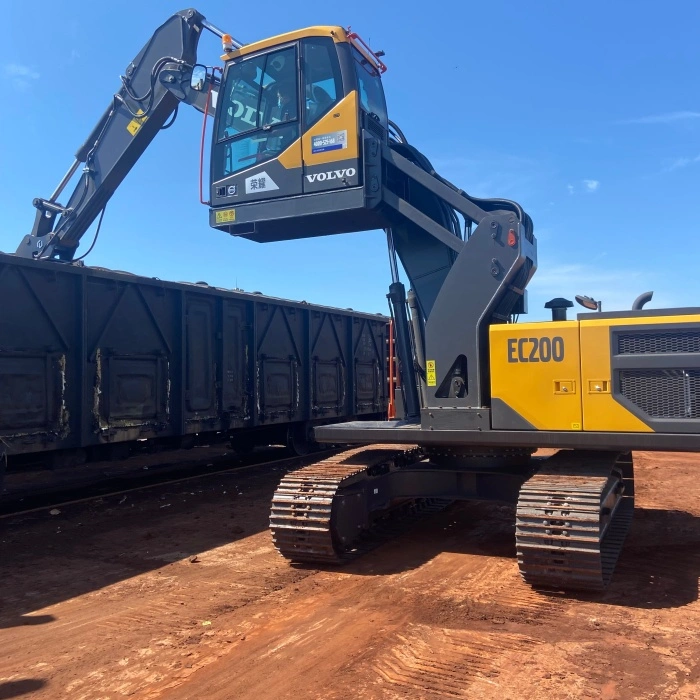
Because the center of gravity increases when the cab is raised, safety is paramount in the design:
Explosion-proof valve (balance valve): This is the most crucial safety feature. Each lifting cylinder is equipped with an explosion-proof valve. In the event of an accidental rupture in the hydraulic lines, the valve immediately locks the cylinder, preventing the cab from plummeting instantly. It will only descend very slowly, protecting the operator's safety.
Emergency operation: In addition to the main control handle inside the cab, an emergency operation handle is also located outside the excavator in case of emergencies.
Control system: A pilot-operated proportional handle and a hydraulically controlled directional valve are also used, making the cab raising and lowering process smoother and more comfortable, reducing swaying.
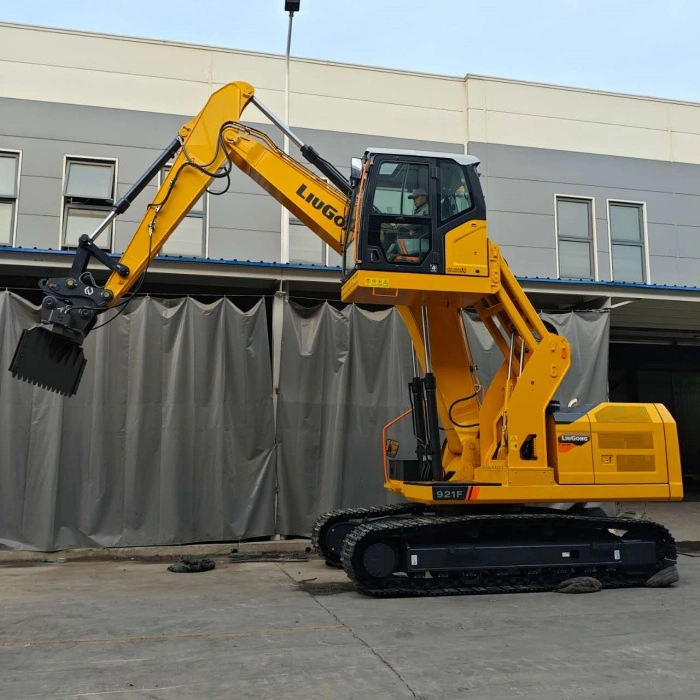
Railways and Logistics: Train Leveling and Bulk Cargo Loading/Unloading
This is one of the most typical application scenarios for liftable cabs. During train leveling operations, with the cab raised, the operator can clearly see the interior of the carriages, precisely controlling the grab bucket or leveler for unloading and leveling, effectively preventing material spillage or uneven loading. Similarly, in railway bulk cargo transfer stations, the improved visibility makes loading and unloading operations more efficient and accurate.
Ports and Terminals: Bulk Material and Piece Cargo Loading/Unloading
At ports, whether loading and unloading mountains of ore or grabbing bulky logs, a clear view is crucial. Liftable cabs allow operators to overlook the entire stockpile or hold, precisely grabbing and placing materials, significantly improving loading and unloading efficiency and safety.
Steel and Scrap Steel Handling: Scrap Steel Loading
The scrap steel handling area in steel plants has a complex environment; scrap steel is irregularly shaped and piled haphazardly. In this case, the raised cab provides the operator with a comprehensive view, enabling precise grabbing and placement of scrap steel, ensuring both operational accuracy and safety.
Construction Projects: Slope Construction and Site Leveling
When constructing on slopes, excavating deep pits, or leveling large areas of land, fixed-height cabs often present blind spots. By raising the cab, operators can have a complete view of the work area, allowing for more precise control of excavation depth and slope smoothness, thus ensuring construction quality. Furthermore, it effectively reduces blind spots during daily operations.