

Excavator Buckets: The Ultimate Guide to Choosing the Right Bucket for Your Machine & Job Site
Introduction
The excavator bucket is arguably the most essential attachment on any excavation project. It's the business end of your machine—the component that directly engages with the material, moves the earth, and determines your productivity.
But here's the truth that separates profitable contractors from the rest: Not all buckets are created equal. Using the wrong bucket for your application doesn't just slow you down—it costs you money. Worn-out edges, cracked side plates, and inefficient loading cycles all eat into your bottom line.
| Bucket Type | Material Grade | Application | Durability Level |
|---|---|---|---|
| Standard Bucket | Q345 Alloy Steel | Clay, sand, topsoil, light gravel | Light to Medium |
| Heavy-Duty Bucket | NM360 Wear Steel | Hard soil, compacted gravel, mixed debris | Medium to Heavy |
| Rock Bucket | HARDOX (Imported) | Rock, blasted ore, frozen ground, demolition | Extreme |
In this guide, we'll break down everything you need to know about excavator buckets—from types and materials to sizing and maintenance. Whether you're digging utility trenches in soft soil or ripping through granite in a quarry, you'll leave with the knowledge to choose wisely.
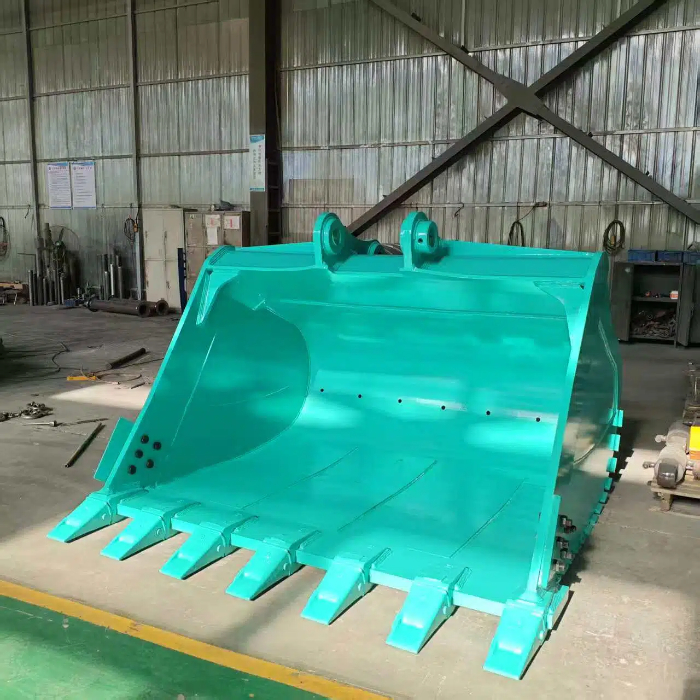
What Is an Excavator Bucket?
An excavator bucket is an attachment mounted to the end of an excavator's arm, designed for digging, scooping, and transporting material. Structurally, it consists of the bucket body, floor, side walls, cutting edge or tooth system, and mounting interfaces for the quick coupler -2.
The bucket operates primarily as a passive attachment—it doesn't have its own hydraulics. Instead, it leverages the excavator's breakout force and tear-out power to penetrate and move material -2.
In simple terms: Your excavator delivers the power. Your bucket delivers the results.
The Main Types of Excavator Buckets
1. Standard / General Purpose Buckets
The "workhorse" of the construction site. Standard buckets are designed for versatility rather than specialization.
Materials handled: Clay, loam, topsoil, sand, gravel
Construction: Q345 alloy steel with standard plate thickness -7
Best for:
General excavation and loading
Site preparation
Landscaping and farming
Light demolition cleanup
Why choose standard:
Lower initial cost than specialized buckets
Wide availability in all sizes
Suitable for 80% of routine jobs
Limitation: Moderate durability. If you're working in abrasive or rocky conditions regularly, you'll wear through a standard bucket quickly -4.
2. Heavy-Duty Buckets
Heavy-duty buckets bridge the gap between general-purpose and extreme-duty applications. They feature reinforced construction at wear points, including thicker bottoms and side wear plates.
Materials handled: Hard soil, compacted gravel, clay with rocks, demolition debris
Construction: NM360 high-strength wear steel at tooth seats and side rails -7
Key features:
Reinforced bottom and side plates
Pre-drilled holes for optional side cutters
Extended wear life compared to standard buckets
Shroud protectors available
Best for:
Heavy construction projects
Infrastructure repair
Site preparation in abrasive soil
Mixed material handling
Why choose heavy-duty:
2-3x longer wear life than standard buckets
Lower maintenance costs over time
Can handle occasional rock exposure
Savings tip: Heavy-duty buckets typically cost more upfront but deliver significant long-term savings through reduced downtime and fewer replacements -4.
3. Rock Buckets
Rock buckets are purpose-built for the toughest applications. If you're working in blasted rock, quarry overburden, or frozen ground, this is your bucket.
Materials handled: Hard rock, blasted ore, frozen ground, caliche, concrete demolition
Construction: HARDOX ultra-high-strength wear steel (Swedish imported) with double-bottom design -5
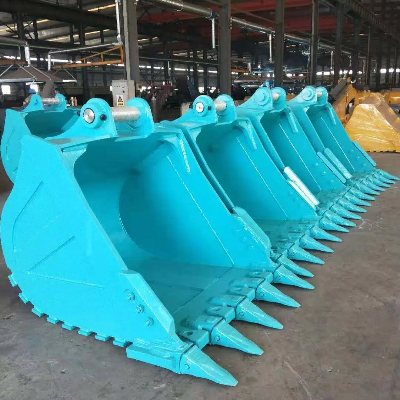
Key features:
Double-arc bottom design increases ground clearance at heel and reduces wear
Heavy-duty rock teeth and tooth holders
Side armor plates for additional protection
Gap-adjustable bushing at dipper connection
Structural components: Tooth seat plate, bottom plate, double bottom reinforcement, side plates, cheek plates, hinge plates, back plate, bucket ears, bucket bushings, rock-type teeth and holders, protective plates -5
Best for:
Quarry and mining operations
Tunneling and heavy rock excavation
Demolition of reinforced concrete
Road construction in rocky terrain
Why choose rock:
Designed for high-impact conditions
Maximum abrasion resistance
Can penetrate materials that would destroy standard buckets
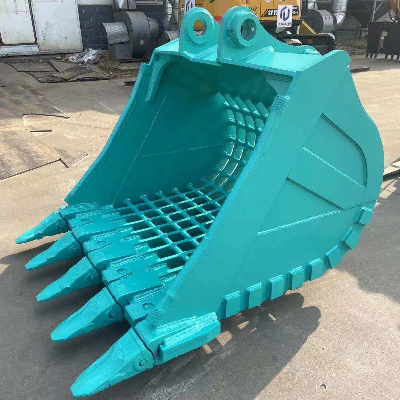
Grade classification by machine size -5:
| Grade | Machine Weight |
|---|---|
| HD Type | 20-30 tons |
| SD Type | 30-60 tons |
| XD Type | 60-120 tons |
4. Skeleton / Screening Buckets
Skeleton buckets look like standard buckets but with spaced bars along the bottom and sides. This design allows fine material to fall through while retaining larger debris.
Primary function: Material separation on site
Best for:
Separating dirt from rocks and roots
Cleaning up demolition debris
Topsoil preparation for landscaping
Agriculture (rock removal from fields)
Recycling and waste sorting
Key advantage: Eliminates secondary screening operations. What comes out is sorted material, ready for use or disposal.
Typical applications by industry:
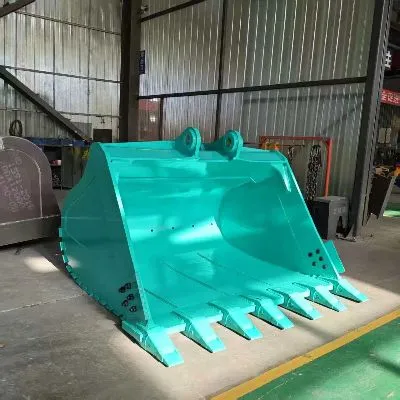
| Industry | Use Case |
|---|---|
| Agriculture | Rock and debris separation from soil |
| Construction | On-site material sorting |
| Land Clearing | Vegetation and rock separation |
| Demolition | Concrete and rebar segregation |
| Landscaping | Topsoil preparation |
| Scrap Handling | Material classification |
5. Trenching Buckets
Trenching buckets are narrow, deep buckets designed for utility work. Their sharp teeth and compact geometry allow precise digging without disturbing surrounding areas.
Typical widths: 3 to 6 inches (75-150mm) -4
Best for:
Pipeline and cable installation
Drainage systems
Narrow foundations
Irrigation trenches
Why choose trenching:
Precision digging minimizes over-excavation
Less backfill material required
Clean trench walls reduce manual cleanup
6. V-Buckets (Trapezoidal Buckets)
V-buckets feature a V-shaped design that creates trenches with sloped sides—ideal for drainage systems and pipe bedding.
Best for:
Sloped drainage trenches
Pipe bedding profiles
Any application requiring angled trench walls
Advantage over trenching buckets: The V-shape creates self-supporting trench walls, reducing collapse risk and improving water flow.
7. Tilt Buckets
Tilt buckets include a hydraulic mechanism that allows up to 45° of tilt in either direction. This flexibility reduces the need to reposition the excavator for angled work.
Best for:
Grading slopes and embankments
Contouring landscapes
Cleaning ditches and waterways
Working on uneven terrain
Productivity impact: One operator can complete tasks that would otherwise require constant machine repositioning.
8. Ripper Buckets
Ripper buckets combine ripper teeth with bucket capability, designed to break through hard or frozen surfaces before scooping.
Best for:
Breaking frozen ground
Coral and sandstone excavation
Limestone and shale removal
Structural demolition preparation
Asphalt breaking
Key feature: Reinforced teeth structure can withstand the stress of penetrating surfaces that would bend standard bucket teeth.
Bucket Material Grades Explained
The material your bucket is made from directly determines its lifespan and application suitability.
Q345 / 16Mn (Standard Grade)
Application: Light to medium duty
Properties: Good weldability, moderate strength
Best for: Clay, sand, topsoil
NM360 (Heavy-Duty Grade)
Application: Medium to heavy duty
Properties: High-strength wear-resistant steel
Best for: Hard soil, gravel, mixed debris
HARDOX (Extreme Duty / Rock Grade)
Application: Extreme duty
Properties: Ultra-high-strength abrasion-resistant steel (Swedish imported)
Best for: Rock, blasted ore, frozen ground, heavy demolition
The hierarchy: Standard → Heavy-Duty → Rock corresponds directly with increasing material hardness, wear resistance, and cost—but also with increasing lifespan in harsh conditions.
How to Choose the Right Bucket Size
The right bucket size balances three factors: machine capability, material density, and truck capacity.
1. Match Your Excavator Class
Using a bucket designed for a 30-ton machine on a 15-ton excavator will damage both components. Conversely, an undersized bucket on a large machine wastes capacity.
| Machine Weight | Typical Bucket Capacity (Heaped) |
|---|---|
| 6.3 tons | 0.25 - 0.40 m³ |
| 8.0 tons | 0.35 - 0.60 m³ |
| 10.0 tons | 0.50 - 0.80 m³ |
| 12.5 tons | 0.60 - 1.00 m³ |
| 15.0 tons | 0.70 - 1.20 m³ |
| 20.0 tons | 0.95 - 1.60 m³ |
| 25.0 tons | 1.20 - 2.00 m³ |
| 32.0 tons | 1.40 - 2.40 m³ |
| 40.0 tons | 1.80 - 3.00 m³ |
| 50.0 tons | 2.50 - 4.00 m³ |
| 63.0 tons | 3.50 - 5.50 m³ |
Source: Industry standard sizing guide -3
2. Consider Material Density
Heavy materials (rock, ore, wet clay) require smaller buckets than light materials (topsoil, mulch, light debris). A large bucket on heavy material can overload the machine, slowing cycle times and increasing wear.
Rule of thumb: If your machine lugs or stalls when curling the bucket, you're oversized.
3. Match Your Haul Trucks
The bucket should fill your haul trucks in an integer number of passes—preferably 3 to 5 passes per truck. Odd counts (like 4.7 passes) indicate mismatched sizing.
Calculated poorly: One 4.7-pass truck means operators either overload (safety risk) or underload (wasted capacity).
Calculated correctly: A truck that takes exactly 5 passes eliminates guesswork.
Bucket Capacity Calculation
Bucket capacity is typically measured in two ways -3:
| Method | Formula | Use Case |
|---|---|---|
| Struck Capacity | Height × Depth × Width × 0.65-0.75 | Conservative estimates |
| Heaped Capacity | Height × Depth × Width × 0.85-0.95 | Standard for production |
Heaped capacity is the industry standard, representing the volume achievable with proper loading technique.
Quick Couplers: The Productivity Multiplier
If you use multiple bucket types on a job site, a quick coupler transforms your workflow. These devices allow operators to switch between buckets in seconds—without leaving the cab.
Benefits of quick couplers:
Reduced downtime: Change buckets in under 30 seconds vs. 10+ minutes manually
Machine utilization: One excavator handles multiple tasks without returning to the shop
Operator convenience: No pins, no tools, no helper required
Safety: No manual handling of heavy pins and bushings
As one industry expert notes, "Using quick couplers correctly ensures high productivity, increased fuel savings, and reduced wear" -6.
Compatibility note:
Ensure your quick coupler matches both your excavator and all bucket pin geometries. Mismatched couplers are a safety hazard.
Wear Protection: Extending Bucket Life
Your bucket takes abuse. Wear protection packages can dramatically extend its service life.
Common wear protection elements:
Side wear plates: Replaceable plates on bucket sides
Bottom wear strips: Reinforced strips along the bucket floor
Corner protectors: Protects leading edges from rounding
Shrouds: Protect between teeth
Reversible cutting edges: Flip when worn for double life
Custom wear packages are available from most manufacturers, designed specifically for your application -10.
Bucket Selection Decision Matrix
Use this guide to match your application to the right bucket type:
| If you're working in... | Start with... | Upgrade to... |
|---|---|---|
| Clean topsoil, sand | Standard | — |
| Clay, hard-packed dirt | Heavy-Duty | — |
| Mixed gravel, demolition debris | Heavy-Duty | Rock (if rocks >6") |
| Blasted rock, quarry | Rock | — |
| Frozen ground, caliche | Ripper | Rock |
| Trenches for utilities | Trenching | V-Bucket (for drainage) |
| Material separation | Skeleton | — |
| Slopes and grading | Tilt | — |
Maintenance Tips for Maximum Bucket Life
Check teeth regularly: Worn teeth increase fuel consumption by up to 20%. Replace before they're completely gone.
Inspect wear plates: Replaceable wear plates exist for a reason. Worn plates expose structural steel.
Grease pivot points: Bushings and pins need regular lubrication. Dry pins wear rapidly and damage ears.
Watch for cracking: Hairline cracks in side plates or bottoms propagate quickly in heavy use. Weld immediately.
Match teeth to material:
Sharp, pointed teeth: Penetrating hard ground
Wide, flat teeth: Bucket edge protection in abrasive material
Rock teeth: Heavy impact and abrasion
Avoid overloading: The bucket may hold more than the machine can safely lift. Respect lift charts.
Conclusion
The excavator bucket is far more than a steel box with teeth. It's a precision tool that directly impacts your productivity, fuel consumption, and operating costs.
The bottom line:
Soft, clean material → Standard bucket
Mixed, abrasive material → Heavy-Duty bucket
Rock, frozen ground, demolition → Rock bucket
Specialized tasks → Specialty buckets (trenching, tilt, skeleton)
Smart money doesn't buy the cheapest bucket. Smart money buys the right bucket for the job and maintains it properly.
Whether you're digging footings for a housing development, laying pipe across highway corridors, or loading blasted rock in a quarry, there's a bucket engineered for your specific application.
About Shandong Tiannuo Construction Machinery
SHANDONG TIANNUO CONSTRUCTION MACHINERY CO., LTD.
Add: No.369, Hard Innovation Industrial Park, Deyuan Road, Yanzhou District, Jining City, Shandong Province, China
Website: www.stnd-machinery.com
Email: arm@stnd-machinery.com