

How TNXZC75 Ballast Transportation Car Boosts Railway Track Construction Efficiency
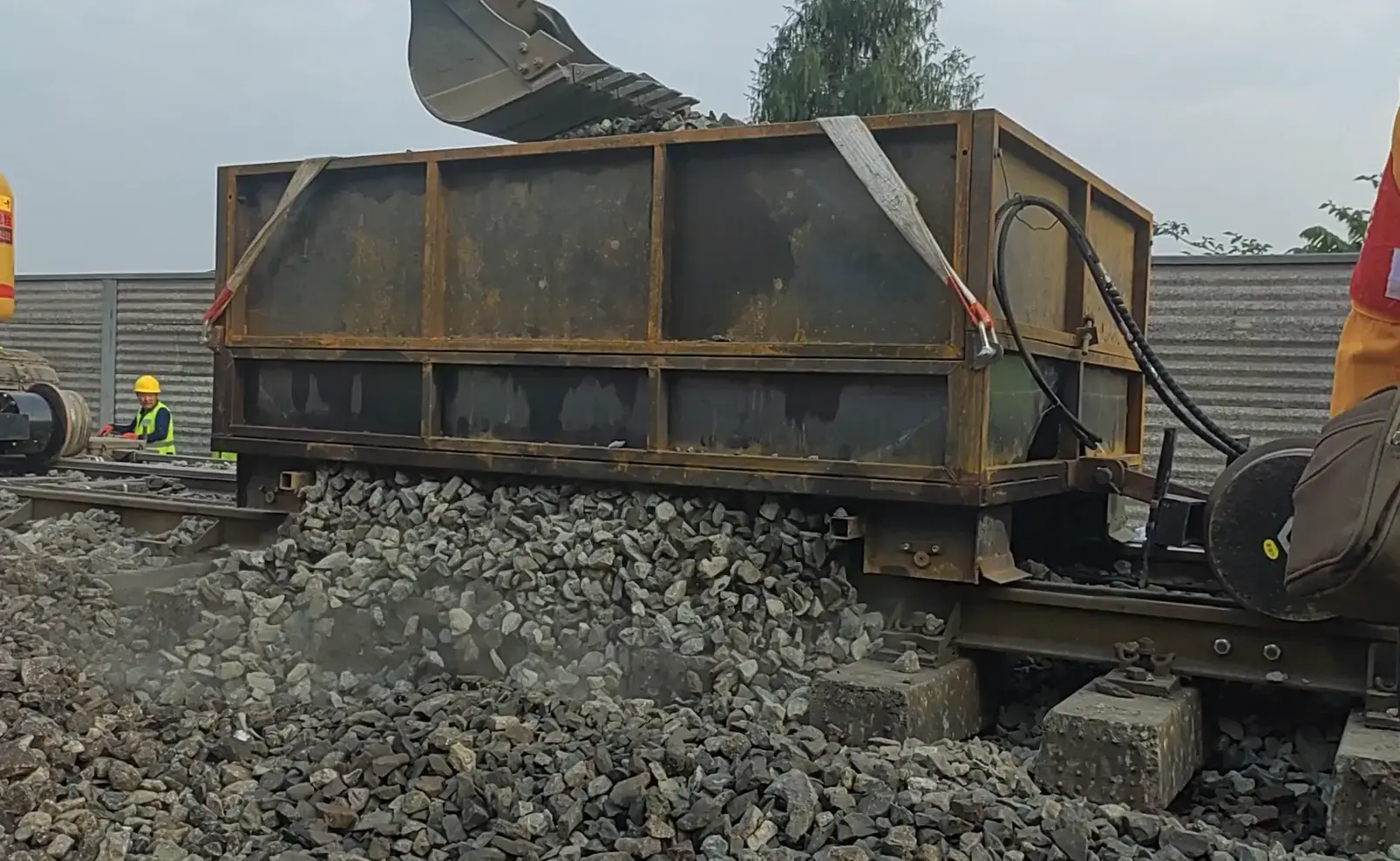
Ballast almost never fails to reach the project. It fails to reach the sleeper. Aggregate arrives at the railhead by the wagonload, is tipped into a stockpile beside the formation, and then has to travel the final few hundred metres to the exact point of placement - usually by wheelbarrow, shovel and a crew working against the clock. That final leg is where maintenance windows are lost, where labour cost concentrates, and where ballast quantities stop being controllable. The TNXZC75 ballast transportation car exists to remove that leg entirely: it runs on the track itself, is handled by the excavator or track machine already on site, and discharges ballast through hydraulically operated bottom doors directly into the crib where it is needed.

Why the Final Leg Costs More Than the Haul
The economics of railway ballast are counter-intuitive. Bulk transport to site is a solved, competitively priced logistics problem. The unsolved part is distribution along the formation, and it carries three costs that rarely appear in a tender comparison:
The window cost. Maintenance possessions are fixed and short. Every minute spent barrowing ballast from a stockpile to the work face is a minute not spent tamping, replacing sleepers or lifting track. Manual distribution consumes the most valuable resource on the project - authorised time on the line.
The labour cost. Manual ballast handling is one of the last genuinely unmechanised tasks in track work. It is physically punishing, needs a large crew for a short burst of output, and produces inconsistent results depending on who is holding the shovel.
The over-supply cost. When ballast cannot be placed precisely, crews compensate by tipping generously and redistributing afterwards. Material that ends up outside the crib is material paid for, transported and then handled a second time.
A ballast transportation car attacks all three at once, not by moving ballast faster, but by changing where the discharge point is. When the container travels on the rail to the work face and opens underneath itself, the stockpile-to-crib leg simply disappears from the programme.

What Is a Ballast Transportation Car?
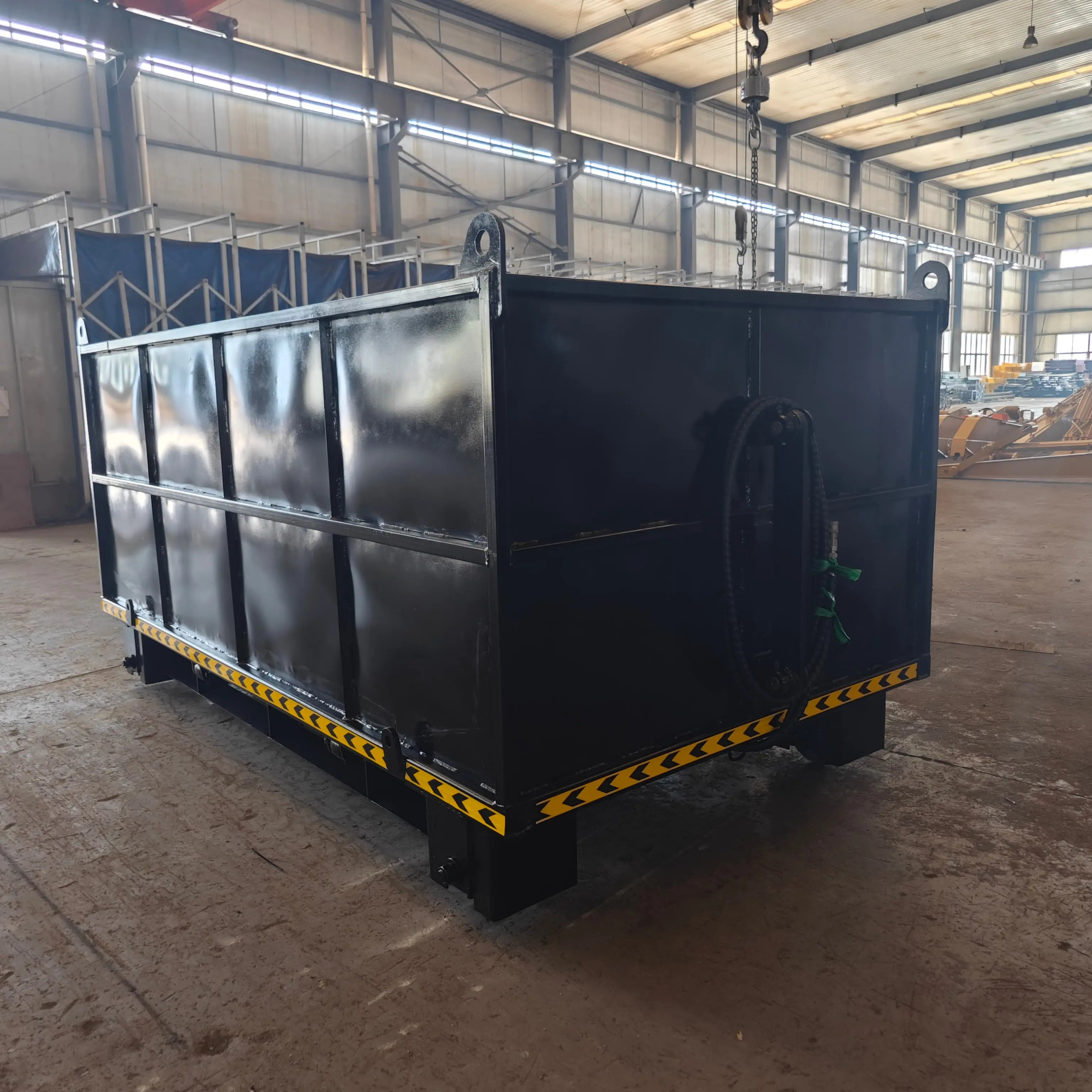
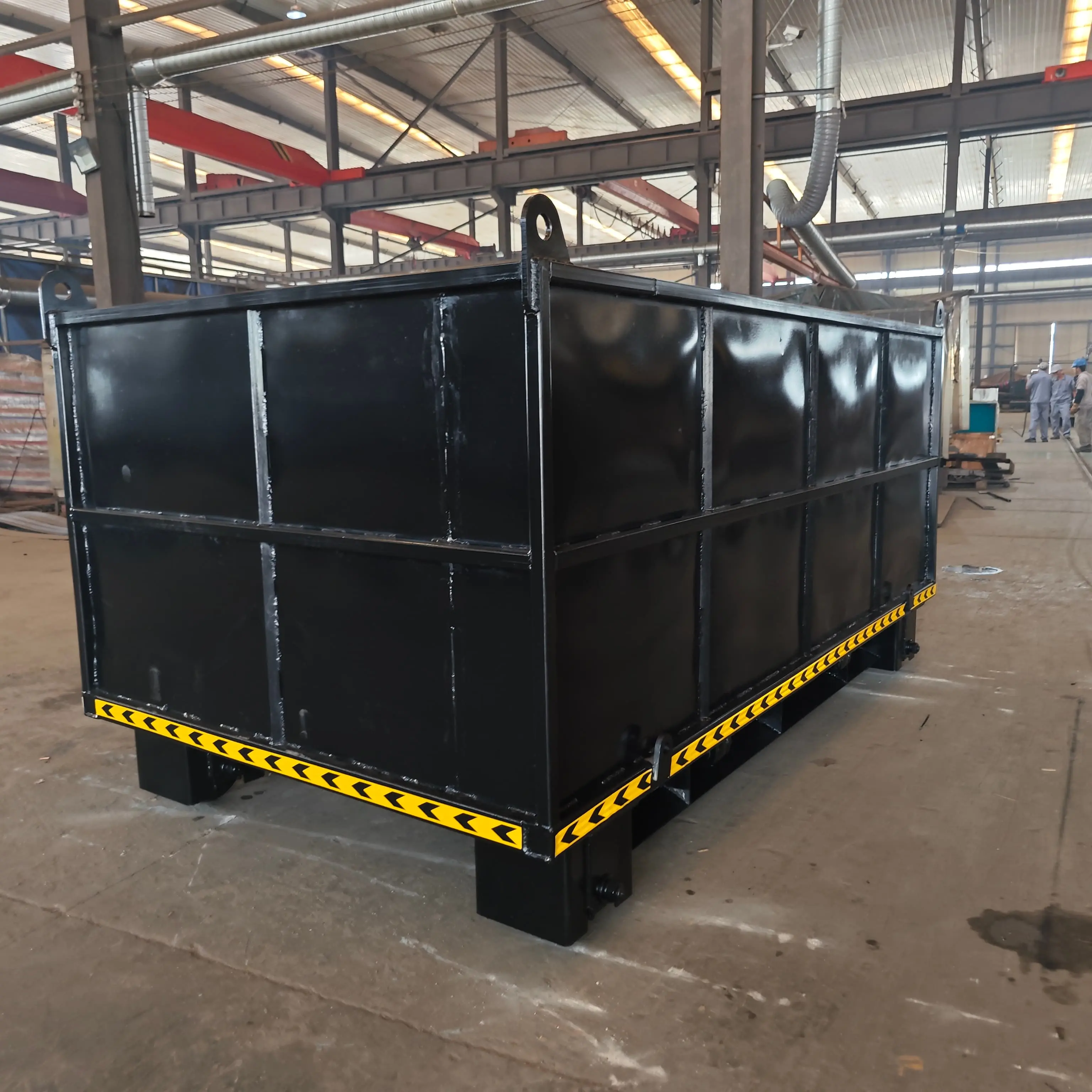
The TNXZC75 ballast transportation car - also referred to as a ballast hopper car, ballast transport wagon or rail ballast trolley - is a rail-borne steel container designed to carry and place track ballast during construction and maintenance. It is not a self-propelled wagon and does not need to be. It is designed to work in conjunction with the track machine or excavator already deployed on the job, which provides both the movement and the hydraulic power.
Its purpose is deliberately narrow, and that is its strength. It carries 5.5 cubic metres of ballast on 1435 mm standard gauge track, it goes exactly where the track goes, and it discharges on command. There is no engine to maintain, no separate power pack to fuel, and no operator licence beyond the machine already working the site.
The Quick-Plug Hydraulic Door: The Detail That Defines This Product
If you compare ballast containers on a specification sheet alone, they look interchangeable: a steel box with dimensions and a volume. The functional difference is in how the doors are controlled, and this is where the TNXZC75 is engineered rather than merely fabricated.

Hydraulic power drawn from the track machine
The car carries no hydraulic power unit of its own. Its oil pipe is fitted with a quick plug that connects directly into the oil circuit of the track machine, and that circuit drives the opening and closing of the ballast doors. The commercial logic is straightforward: you are already paying for a hydraulic machine on site, so the ballast car should consume that power rather than duplicate it. No engine, no pump, no fuel line, no separate maintenance schedule.
Quick-plug coupling for fast changeover
The quick-plug connection matters more than it sounds. In a short possession, the difference between a coupling that takes seconds and one that requires spanners and spilled oil is the difference between running three loads and running two. It also means one machine can work multiple cars in rotation - connect, position, discharge, disconnect, move to the next.
Controlled discharge instead of dumping
Because the doors are hydraulically actuated rather than simply released, discharge is a controlled operation. The operator opens the doors from the machine, ballast flows out under the container along the track, and the doors close again. This is the mechanism that converts ballast placement from an approximate, shovel-corrected activity into a repeatable one.

Two Unloading Modes, Two Different Jobs
The TNXZC75 offers bottom hydraulic unloading and side manual unloading. These are not redundant options; they serve genuinely different placement tasks, and knowing which to use is most of the operational skill required.
Bottom hydraulic unloading - the primary production mode. Ballast is released downward through the floor doors, straight into the crib and shoulder area beneath the car. This is what you use for continuous ballast laying along new line construction and for large-volume replenishment, where the objective is even distribution along a length of track with minimal handling afterwards.
Side manual unloading - the precision mode. Side discharge is operated manually, which gives the crew direct control over how much material goes where. This is the mode for spot replenishment, for topping up a specific low section, for shoulder work, and for any situation where a measured quantity matters more than throughput.
In practice most crews use both within a single shift: bottom discharge to lay the bulk of the material at pace, side discharge to finish and correct. A container offering only one mode forces a compromise on one of those two jobs.
TNXZC75 Ballast Transportation Car: Full Technical Specification
Two figures below deserve attention before the rest. The 5.5 m3 capacity determines how many trips your window allows. The 1580 kg self weight determines whether your excavator can lift and place the car comfortably - check it against your machine lift chart at the working radius you will actually use, not at maximum capacity.
Item | Unit | TNXZC75 |
Length | mm | 3300 |
Width | mm | 1850 |
Height | mm | 1550 |
Weight (self weight) | kg | 1580 |
Capacity | m3 | 5.5 |
Applicable Track Gauge | mm | 1435 |
Applicable Machine | - | Excavator |
Unloading Ballast Type | - | Bottom hydraulic unloading / side manual unloading |
Hydraulic Power Origin | - | Supplied from the track machine |
Packing Size | mm | 3440 x 1950 x 1680 |
Note: the standard car is built for 1435 mm standard gauge. As a source factory we also manufacture to other gauges and to adjusted container dimensions on request.
Where the Ballast Transportation Car Earns Its Keep
New railway line construction
During initial ballast laying, material has to be distributed continuously along a formation that has no road access and no established haul route. The car uses the track being built as its own delivery road, advancing with the work front rather than depending on parallel ground access.
Major renovation of factory and mine dedicated lines
Industrial sidings and mine spur lines are the classic problem case. They are often hemmed in by plant structures, stockpiles and operating traffic, so bringing a road truck alongside the track is either awkward or impossible. A rail-borne container sidesteps the access problem completely, which is precisely the application this model was developed for.
Ballast replenishment and routine maintenance
Track loses ballast steadily through attrition, pumping and tamping losses. Replenishment is high-frequency, low-volume work where mobilising heavy plant is disproportionate. Side manual discharge suits this pattern exactly: bring the measured quantity to the location that needs it, place it, move on.
Tunnel, bridge and confined-access sections
Anywhere the formation is bounded - tunnels, bridge decks, cuttings, urban corridors between walls - road-based ballast delivery stops working. Rail-borne delivery does not care about lateral access, because it approaches along the alignment itself.
One Excavator, a Complete Ballast Workflow
The strongest argument for this product is not the container in isolation; it is what it completes. An excavator fitted with rail gear and a set of attachments already performs excavation, ballast cleaning, sleeper handling and tamping. What it typically cannot do is move bulk ballast along the line - so ballast distribution stays manual even on an otherwise mechanised site, and becomes the bottleneck that sets the pace for everything else.
Adding a ballast transportation car closes that gap using the same host machine and the same hydraulic circuit. The result is a single-machine ballast workflow: excavate or clean, place sleepers, deliver ballast by rail, discharge to the crib, tamp, and move forward. No second power source, no additional operator, no dependence on ground access parallel to the track.
A Four-Point Check Before You Order
1. Confirm your track gauge
The standard TNXZC75 is built for 1435 mm. If your network runs a different gauge, tell us the figure at enquiry stage - the running gear is manufactured to gauge and this is not a field adjustment.
2. Check the 1580 kg self weight against your machine
Your excavator must place and retrieve the empty car safely at realistic working radius. 1580 kg is the empty weight; verify it on your lift chart rather than against the machine tonnage headline.
3. Confirm your hydraulic interface
The door circuit runs from the track machine through a quick plug. Send us the coupler type and hydraulic parameters of your machine so the connection is correct on arrival instead of being adapted on site.
4. Plan the fleet size around your window, not around the car
One car holds 5.5 m3. Divide the ballast volume your possession requires by that figure to find the number of cycles - then decide whether it is cheaper to run one car repeatedly or to operate two or three in rotation so the machine never waits. For most window-constrained projects, rotation is the answer.
Why Source Your Ballast Transportation Car From Tiannuo
Shandong Tiannuo Construction Machinery is a source factory in Jining, Shandong, with over ten years of manufacturing experience across excavator attachments, excavator modifications, long-reach fronts and railway maintenance equipment. Railway track work is not a sideline for us - we build the ballast cleaning buckets, sleeper clamps, tamping units, rail clamps and track trolleys that operate alongside this car, which is why the ballast transportation car is designed as part of a workflow rather than as an isolated steel box.
Because you are dealing with the production line rather than a trading intermediary, gauge, dimensions, door configuration and hydraulic interface are all specification decisions we can make with you, not fixed catalogue limits you have to work around.
Get a Ballast Delivery Plan, Not Just a Price
Tell us three things - your track gauge, the excavator or track machine you will use, and the ballast volume a typical possession requires. We will come back with the recommended configuration, the number of cars needed to keep your machine working through the window, the hydraulic connection specification and a full quotation including packing and shipping dimensions.

Shandong Tiannuo Construction Machinery Co., Ltd.
Add: No. 369, Hard Innovation Industrial Park, Deyuan Road, Yanzhou District, Jining City, Shandong Province
Website: www.stnd-machinery.com Email: arm@stnd-machinery.com