

Lingong 155 Rail Machine: A Professional Retrofit Solution for Railway Maintenance Equipment
A Specialized Modification Solution for Railway Maintenance Equipment
SDLG 155 Rail-Road Excavator—The Professional Choice for Railway Maintenance Operations
In the fields of railway line maintenance and engineering construction, rail-road excavators are increasingly becoming vital equipment for enhancing operational efficiency. Converting a standard excavator into a dual-mode rail-road machine allows it to leverage its original earthmoving capabilities while also meeting the requirements for traveling and operating directly on the rails. This article focuses on the SDLG 155 (E6155H) excavator, outlining the technical solution and configuration features involved in its conversion into a rail-road excavator.
The SDLG 155 is a medium-sized hydraulic excavator with an operating weight of approximately 13.6 tons; it is equipped with an 89 kW engine and delivers a maximum digging force of 93.9 kN. With its robust power output and hydraulic system, this model provides an excellent foundation for modification, making it well-suited for railway tasks such as sleeper replacement, ballast clearing, and material handling. Key Modification Specifications for the SDLG 155 Rail-Road Excavator
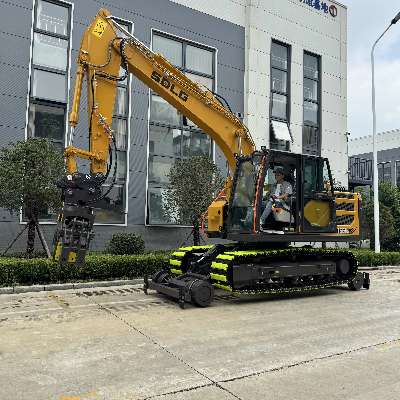
The rail-road excavator, modified from the SDLG 155 model, incorporates the following key systems and devices
Dual-Mode Rail/Road Chassis: A rail travel system is installed, enabling the machine to operate on standard-gauge rails and switch freely between road and rail operating modes.
Rubber Pads and Reversing Alarm: Rubber pads reduce impact and noise during contact between steel wheels and rails; the reversing alarm issues a warning when the machine moves backward, ensuring the safety of personnel in the work area.
Emergency Engine: Provides backup power in the event of a primary power system failure, ensuring the machine can safely clear the track area.
Boom Height and Swing Limiters: These control the boom's lifting height and slewing angle, preventing collisions with overhead contact lines or other structures during operation and ensuring compliance with railway clearance requirements.
Mechanical Height Limiter and Insulation Frame: The mechanical height limiter serves as a safety redundancy, while the insulation frame ensures electrical safety when the machine operates in electrified railway sections.
Alarm System: Emits audible and visual warning signals during machine movement or operation.
Dual Control Systems: Specifically designed to control the rotation and clamping actions of the sleeper changer, enhancing the precision and efficiency of sleeper replacement operations.
Additionally, rail-road excavators typically require an anti-tipping mechanism; a rail-gripping device is used to counteract tipping moments during curved-track operations or boom rotation, thereby ensuring operational stability.
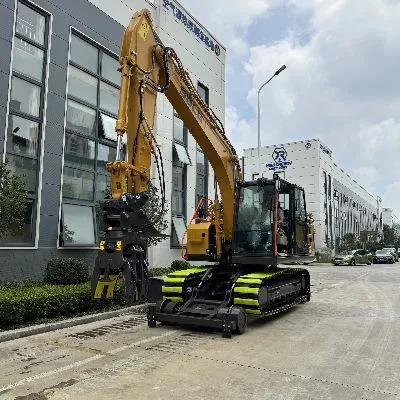
Prerequisites and Considerations for Rail-Road Modification
Converting the SDLG 155 excavator into a rail-road machine requires an assessment of the base unit's specifications. Based on standard industry modification requirements, the following points warrant special attention:
1. Dozer Blade Assembly
To be modified into a rail-road excavator, the machine must be equipped with a dozer blade assembly or have a mounting interface reserved for one. The dozer blade aids in stabilization and positioning during rail travel and operation, making it a fundamental requirement for the modification.
2. Reserved Hydraulic Main Valve Port
A set of hydraulic ports must be reserved on the excavator's main control valve to supply power to the rail travel system (specifically, the hydraulic motors that drive the rotation of the steel wheels). If the main valve lacks reserved ports, the center swivel joint must be replaced, resulting in additional modification costs. 3. Track Gauge Adaptation
Railway lines vary in track gauge. If the gauge is narrow (such as meter-gauge or narrow-gauge lines), the undercarriage must be narrowed during modification to meet the operational requirements of the specific line.
Why Choose the SDLG 155 for Rail-Road Machine Modification?
The SDLG 155 offers excellent adaptability for modification regarding its powertrain and overall structure:
Ample Power: An 89 kW engine paired with a high-displacement main pump meets the power demands for both excavation tasks and the rail travel system.
Hydraulic System Expandability: The high-displacement main pump ensures abundant flow, facilitating the supply of hydraulic fluid to auxiliary equipment such as rail travel motors and sleeper changers.
Machine Stability: With an operating weight of approximately 13.6 tons, the machine provides sufficient mass for rail operations; combined with a dozer blade and an anti-tipping mechanism, it ensures operational safety.
Conclusion
The SDLG 155 rail-road machine is a specialized modification based on the SDLG 155 excavator, suitable for maintenance tasks such as railway sleeper replacement, ballast cleaning, and material transport. Key technical factors to consider during modification include the dozer blade configuration, reserved hydraulic interfaces, and track gauge adaptation. Please contact us for further details on modifications or to obtain a customized solution.