

What is the function of an excavator's rotating tilt bucket?
The rotating tilting bucket is a versatile excavator attachment that can be likened to equipping the bucket with a "wrist" and a "neck," enabling it to flexibly adjust its angle and perform precision tasks without requiring the excavator itself to make extensive movements.
Core Function
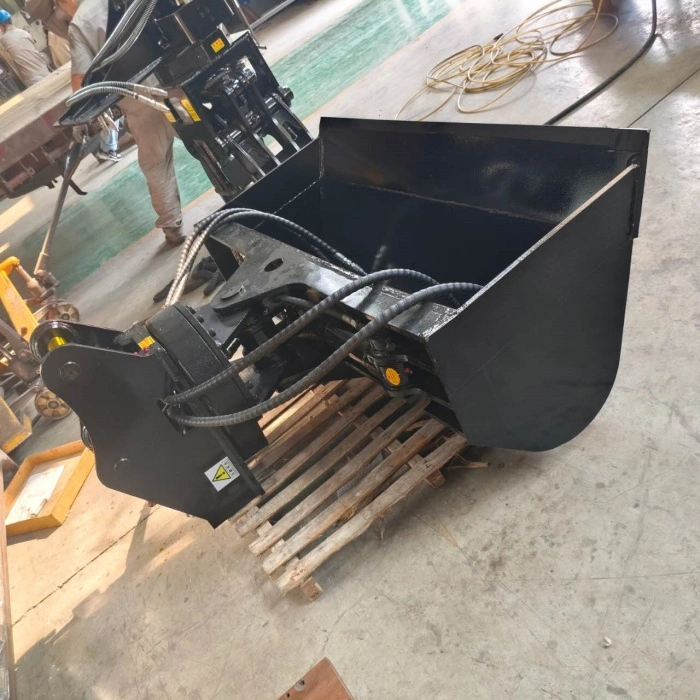
It primarily resolves the limitations of traditional buckets—specifically their fixed angles and the need to frequently reposition the machine body during operation to adjust alignment. Its core functions are as follows:
Enabling Precise Tilting and Rotation: The bucket is capable of bidirectional left-to-right tilting and full 360-degree rotation, allowing the operator to precisely control the angle and orientation of the bucket edge.
Facilitating Precision Work: It is particularly well-suited for tasks requiring "fine-tuning" and meticulous execution—such as slope trimming, trench excavation, and site leveling—where it can keep operational errors within a centimeter-level tolerance.
Achieving Multi-Purpose Versatility: By swapping out different buckets or utilizing the "clamping" function (available on select models), it can perform a wide array of tasks—including gripping, loading, and breaking—making it a truly "multi-functional" attachment in every sense.
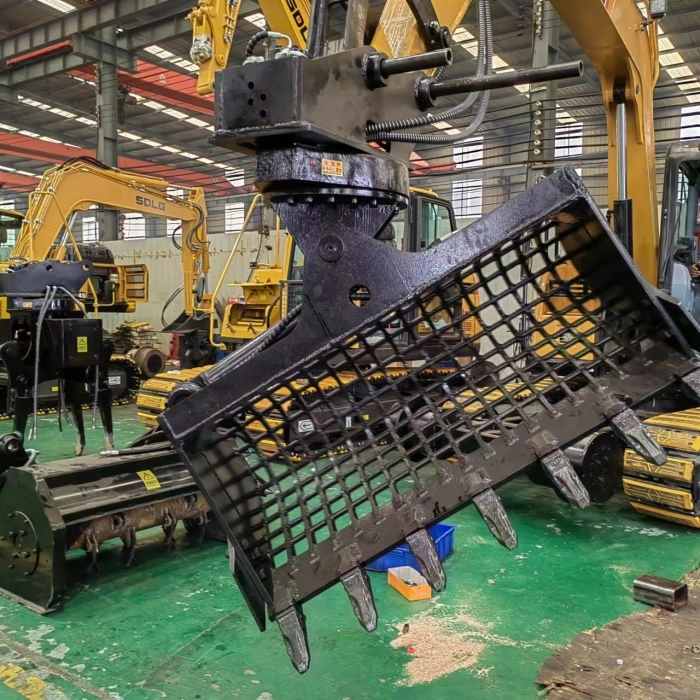
Primary Applications
Thanks to its inherent flexibility, the tilt bucket excels in a wide variety of operating conditions:
Slope and Embankment Work:It eliminates the need for the excavator to position itself sideways; instead, the bucket face can be perfectly aligned with the slope angle to perform efficient and precise grading, trimming, and embankment shaping.
Ditch and Waterway Management: It allows for the single-pass excavation of rectangular or trapezoidal trenches with precise gradients, forming smooth trench walls in a single operation—making it particularly well-suited for water conservancy and drainage projects.
Construction in Confined Spaces: When working in restricted areas—such as alongside buildings or at the base of walls—the machine can remain stationary while the tilting bucket is used to laterally discharge material into a designated spot or a dump truck, thereby significantly reducing the need to reposition the vehicle.
Precision Site Leveling: It is ideal for the precise leveling of road subgrades and the bottoms of building foundation pits, as well as for clearing rubble and debris from construction sites, making site preparation tasks much easier.
River and Environmental Cleanup: Benefiting from its flexible positioning capabilities, it can effectively clear silt, sediment, and debris from the beds of rivers and lakes.
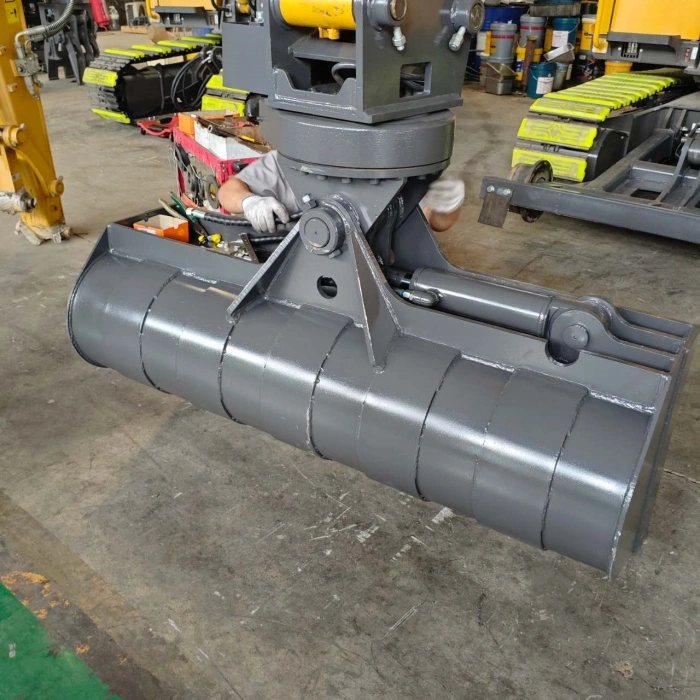
Core Advantages
Compared to standard buckets, its advantages are exceptionally prominent:
High Efficiency & Time Savings: In specific operations—such as slope grading and trenching—efficiency can be boosted by over 30%. Operators no longer need to frequently reposition the machine; complex angle adjustments can be achieved with a single movement.
High Precision:It enables precise hydraulic control over the bucket's orientation, allowing for the effortless execution of intricate tasks that are difficult to achieve with traditional buckets, thereby minimizing the need for rework.
Strong Adaptability: Highly adaptable to a wide variety of complex terrains—whether on slopes or within confined spaces—it demonstrates exceptional flexibility.
Cost-Effectiveness: A single attachment can handle multiple tasks, reducing the time and cost associated with switching between different pieces of equipment, thereby realizing the principle of "one bucket, multiple uses."