

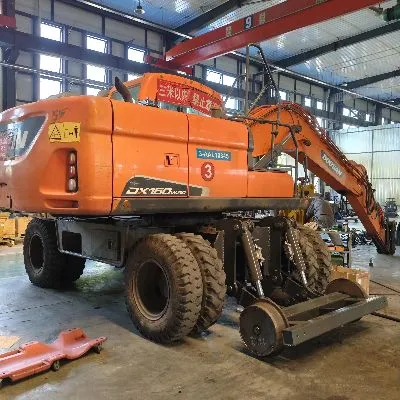
Doosan 150 Rail-Road Excavator
Overview and Market Background of the Railway Excavator Industry
With the continuous expansion and upgrading of global railway networks, the demand for railway maintenance and construction equipment is growing rapidly. Against this backdrop, the road-rail excavator—a specialized piece of equipment capable of moving flexibly on both roads and railway tracks—is emerging as a vital asset in the fields of railway construction and maintenance.
Railway excavator modification refers to the technical retrofitting of standard wheeled or crawler excavators through the installation of a "Rail Guide Wheels System," enabling them to travel and operate safely and efficiently on railway tracks. This modification not only enhances equipment utilization but also significantly boosts the efficiency of railway construction and maintenance operations.
Market Application Scenarios
Typical application scenarios for railway excavators include:
Railway Subgrade Maintenance: Including ballast cleaning, sleeper replacement, ballast replenishment, etc.
Construction Adjacent to Railway Tracks: Excavation of cable trenches, maintenance of drainage systems, slope reinforcement, etc.
Emergency Railway Repairs: Addressing landslides during the rainy season, repairing track deformations, etc.
Early-Stage Railway Construction: Earthworks excavation, loading and unloading, and site leveling operations.
The Three Core Technologies of Railway Excavator Modification
Based on current industry practices, railway excavator modification primarily involves the following core technologies:
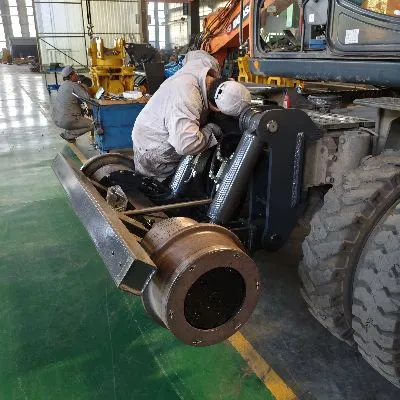
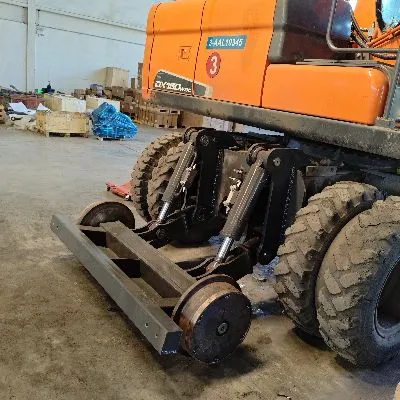
Rail Guide Wheels System
This constitutes the core component of the modification; it typically comprises two sets of guide wheels—one at the front and one at the rear—with a wheel spacing that precisely matches standard railway track gauges (e.g., 1435 mm). Key features of this system include:
Lifting Mechanism: Controls the raising and lowering of the guide wheels via a hydraulic system.
Drive Method: Typically utilizes the excavator's original dual-speed hydrostatic drive system, propelling the machine forward through the frictional force generated between the guide wheels and the rubber tires.
Load Capacity: Typical designs feature a load capacity of less than 15 tons and a travel speed of less than 25 km/h.
Hydraulic System Modification
To meet the specific demands of railway operations, the excavator's hydraulic system requires specialized modification:
Addition of Hydraulic Output Ports: Provides power to the railway travel mechanism.
Optimization of Hydraulic Flow Distribution: Ensures coordinated operation between travel and work functions.
Installation of Safety Interlock Devices: Prevents accidents during operations conducted on the railway tracks.
Safety and Monitoring Systems
Load Monitoring System: Monitors lifting loads in real-time to prevent tipping.
Rear-View Camera System: Ensures safe travel while operating on the tracks.
Fire Suppression System: Complies with railway operational safety regulations.
Case Study: Modification of Doosan Wheeled Excavators
Currently, the domestic market for modified railway excavators is undergoing a period of rapid development. Taking the Doosan DX150W wheeled excavator as an example, its advantages for modification include:
Moderate Weight:Falling within the 15-ton class, it ensures operational stability while meeting the load-bearing requirements of railway bridges.
Ample Power:The hydraulic system flow rate is sufficient to meet the demands of railway operations.
Excellent Mobility:The wheeled design facilitates easy transitions between railway tracks and public roads.
Key Technical Aspects of Modification
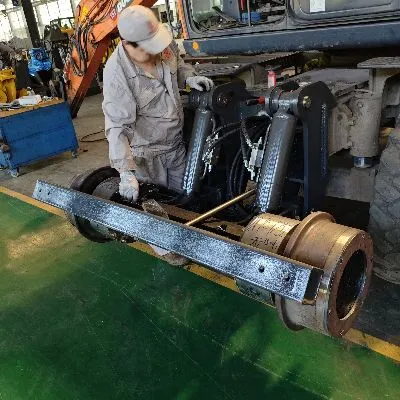
Design of Railway Traveling Gear
In accordance with industry standards, the modification of excavators for railway use must meet the following requirements:
Track Gauge Compatibility: Suitable for the standard track gauge of 1435mm.
Lifting System:Utilizes a hydraulically driven lifting mechanism to ensure smooth raising and lowering.
Guide Wheel Design:Ensures smooth passage, particularly when navigating curved tracks.
Safety Clearance: Maintains a sufficient safety distance between the equipment and railway carriages.
Modular Design Concept
Modern modifications of railway excavators increasingly lean toward a modular design approach:
The railway traveling gear employs a modular structure, facilitating easy assembly and disassembly.
The excavator can be quickly restored to its original configuration whenever necessary.
This approach enhances both the versatility and operational efficiency of the equipment.
Configuration of Work Attachments
The modified railway excavator can be equipped with a variety of specialized work attachments:
Sleeper Spreader:Used for the distribution and laying of sleepers during track construction.
Screening Bucket: Used for cleaning and screening ballast within the track bed.
Sleeper Grab:Used for the removal and replacement of sleepers.
Wide-Mouth Loading Bucket:Enhances the efficiency of material loading and unloading operations.
Safety Design: The Lifeline of Railway Operations
Railway operations demand the highest standards of safety. Professional modification services spare "no expense" when it comes to investing in safety features:
1. Boom Insulation Rack
Prevents accidental contact with high-voltage overhead power lines.
2. Emergency Engine
Activated in the event of a primary engine failure, this auxiliary unit ensures the excavator can be safely moved off the tracks.
V. Market Outlook: The Inevitable Choice for Mechanized Railway Maintenance
Why are railway excavators becoming a dominant trend?
Compressed Time Windows:The "track possession time" (or "maintenance window") available for railway work is shrinking; mechanized operation represents the only viable solution.
Rising Labor Costs: The replacement of manual labor with automated equipment has become an inevitable reality.
Elevated Safety Standards:Specialized equipment is better equipped to meet increasingly stringent safety regulations and protocols.
International experience—particularly in countries such as Austria, Russia, and Poland—demonstrates that railway excavators have already been widely adopted for routine railway maintenance tasks.
Converting a Doosan DX150W wheeled excavator into a road-rail dual-mode machine may appear to be merely a matter of installing an additional travel mechanism; in reality, however, it breathes entirely new life into the equipment. From roadbed maintenance to emergency repair operations, and from ballast cleaning to sleeper replacement, this modified machine is poised to become a true "all-rounder" within railway maintenance teams.