

Why Track Tamping Matters in Modern Rail Infrastructure
In railway maintenance operations, sleeper replacement (re-sleepering) is one of the most disruptive tasks. After old sleepers are removed and new ones installed, the surrounding ballast often becomes loose and uncompacted, leading to a decline in track stability.
Conventional tamping equipment often struggles to effectively address the uneven ballast distribution that follows sleeper replacement. For this very reason, a specialized "dual-head tamping machine" becomes indispensable.
The TNSTDGJ150 and TNSTDCDGJ150 models, introduced by Shandong Tiannuo Engineering Machinery Co., Ltd., are tailor-made specifically for such tasks—they deliver deep, powerful compaction capabilities, thereby enabling the rapid and safe restoration of track geometry.
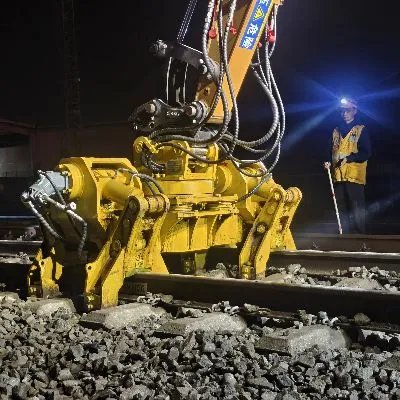
What Makes a Specialized Tamping Machine for Sleeper Replacement Unique?
Unlike standard track maintenance tamping operations, the compaction process following sleeper replacement imposes specific demands on the equipment:
Greater Insertion Depth—to reach and address the deeper layers of disturbed ballast;
Stronger Clamping Force—to tightly compact loose ballast and ensure it fits snugly against the newly installed sleepers;
Flexible Positioning Capability—to execute precise operations around newly installed track components;
Thanks to their robust hydraulic configurations and the operational flexibility afforded by their dual-model design, the TNSTD series machines perfectly meet all of these rigorous requirements.
Key Features Explained: How Technical Specifications Benefit Your Operations
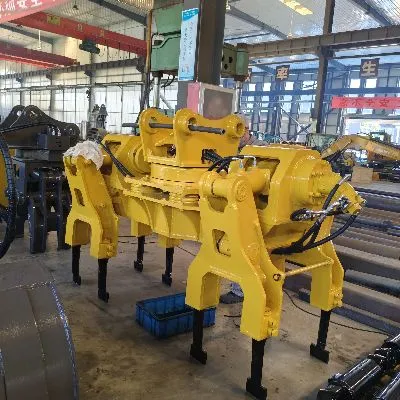
1. 400mm Maximum Tamping Depth
A working depth capability of 400mm ensures that even the deepest layers of disturbed ballast are fully reached. Following sleeper replacement, loose ballast material often settles into the deeper areas beneath the sleepers; relying solely on shallow tamping would leave voids, ultimately leading to future track settlement.
2. 8 Tamping Tines (4 per side)
Most light-duty tamping machines are typically equipped with only 4 to 6 tamping tines. With a configuration of 8 tamping tines, the TNSTD series models provide more contact points during each compaction cycle, resulting in a more uniform distribution of force and effectively reducing the number of tamping passes required. 3. 360° Omnidirectional Rotation
The 360° rotation function is crucial for navigating the various obstacles commonly encountered after sleeper replacement operations—such as rail fasteners, elastic clips, or adjacent infrastructure. Operators can approach the work area and execute operations from any angle. [Suggestion: Including an image here showing the machine rotated 90° and performing tamping operations between two sleepers would be highly illustrative.] 4. 5000 RPM Motor Speed & 400 Bar Pressure
A high-speed hydraulic motor (5000 RPM), combined with a rated pressure of 400 bar, generates the vibratory force necessary to achieve effective ballast interlocking—a process wherein irregular stone particles shift and interlock under vibration, thereby forming a stable trackbed.
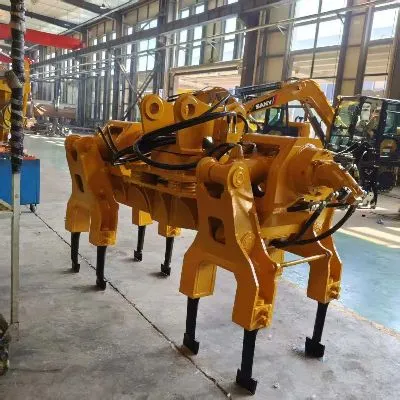
5. Two Models Available
TNSTDGJ150 — Standard configuration; suitable for routine tamping operations following sleeper replacement.
TNSTDCDGJ150 — Features an additional 50° lateral arm tilting function; suitable for operations on sloped shoulders or in confined spaces.
Technical Deep Dive: Synchronous Tamping Action
The design principle behind this dual-head tamping unit mirrors the principles described in patented railway engineering literature: specifically, "synchronous clamping and vibration."
The specific workflow (sequence of actions) is as follows:
Positioning — Utilizing the 360° rotation capability and an adjustable clamping range of 390–625 mm, the device is precisely positioned directly above the target sleeper.
Insertion — The 8 tamping tines descend synchronously, fully penetrating the ballast layer to reach a predetermined depth of 400 mm.
Vibration — The hydraulic system generates vibratory force at a frequency of 40 Hz, effectively reducing internal friction between the ballast particles.
Compaction — The clamping arms retract inward, compressing and packing the ballast particles into the voids beneath and surrounding the sleeper.
Extraction — The tamping tines withdraw smoothly and cleanly, leaving behind a layer of ballast that has been firmly compacted. This sequence of operations is executed sequentially on every sleeper within the sleeper-replacement zone, thereby restoring track stability to a level that meets operational standards.
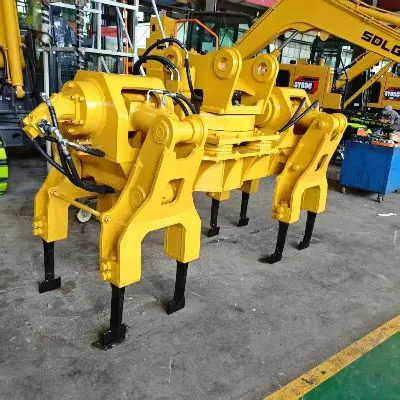
Target Application Scenarios
The TNSTDGJ150 and TNSTDCDGJ150 models are particularly well-suited for the following scenarios:
Sleeper Replacement Projects:A tamping depth of 400mm is sufficient to reach and consolidate the disturbed ballast layer.
Turnout (Switch) Areas: The 360° rotation capability allows for flexible adaptation to complex track geometries.
Tunnel Maintenance Operations:With a total machine weight of 1,850 kg, the unit is ideal for operation within confined spaces.
Mixed-Gauge Lines:Supports dual-gauge operations (1435mm / 1520mm).
Sloped Shoulder Operations:The CDGJ150 model features a 50° lateral arm tilting function, specifically designed for use on embankments and sloped terrain.
Manufacturer Information
Shandong Tiannuo Construction Machinery Co., Ltd. is headquartered in Jining City, Shandong Province—a renowned hub for the construction machinery manufacturing industry in China. Address: No. 369, Yingchuang Industrial Park, Deyuan Road, Yanzhou District, Jining City, Shandong Province, China.
Website: www.stnd-machinery.com
Email: arm@stnd-machinery.com
Conclusion
Following sleeper replacement, loose ballast constitutes not merely an inconvenience, but a significant safety hazard. The TNSTDGJ150 and TNSTDCDGJ150 twin-head tamping machines...